Monday, October 16, 2006

Memorizing the Long March


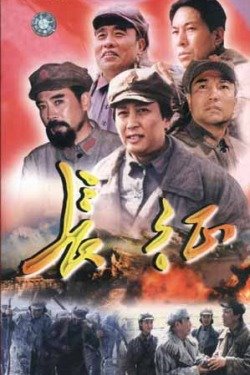
Late leaders Mao Zedong, Zhou Enlai, Zhu De, Liu Shaoqi, featured in a Long-March movie poster


The Chinese government has launched various activities across the country to mark the 70th anniversary of the successful completion of the Long March, a master piece in the history of the communist-lead revolution in China in last century.

The Red Army started the Long March in October 1934, to evade massive attacks from the Nationalist army. They marched thousands of miles across China from east to west, sustaining battles, heavy casualties, famine, wounds and illness, walking through some of the cruelest conditions such as snow mountains and swamps, till they finally accomplished the mission in 1936.

President Hu Jintao visited an exhibition on the Long March in Beijing on Monday. He urged people to remember the great achievements of the revolutionary generation, and inherit their legacy in the current course of building the country, Xinhua reported.
http://news.sina.com.cn/z/changzheng70/index.shtml


Janitors Went on Strike Due to Low Pay
More than 100 city janitors in Lanzhou, Gansu, did not go to clean the streets on Monday, in protest against their under-minimum wages, Western Economic Daily reported.

The province, for which Lanzhou is the capital city, increased its monthly minimum wage to 430 yuan (about $54) in August, but some of the city janitors received only 360 yuan ($45) in October. These workers are mostly hired contemporarily. City government cited financial difficulties for the low payment. Labor Union in the city has pledged to investigate and resolve the problem.
http://news.sina.com.cn/c/2006-10-17/012910249141s.shtml

----by Josie Liu

Thursday, October 12, 2006

Woman Named the Richest in China

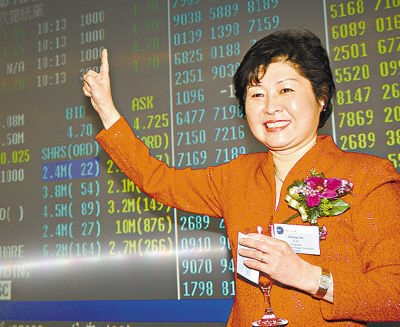
Zhang Yin


The richest entrepreneur now in China, according to the newly released Hurun China Rich List, is Ms. Zhang Yin, Chairwoman of Nine Dragons Paper Industries Company, one of world’s largest manufactures of packaging material based in Dongguan, Gongdong.

Her personal fortune was estimated to be about $3.4 billion, which not only made her the top entrepreneur in China, but also the richest self-made woman in the world - surpassing that of Oprah Winfrey and J.K. Rowling, said Hurun Report, the company that compiled this list.

This is also the first time for a woman to top the China Rich List. The second richest on the list is Mr. Huang Guanyu, with personal fortune amounting at $2.5 billion. There are 35 women on this year’s list, domenstrating the increasing power of women in the private sector of Chinese economy.

Ms. Zhang, 49, was born into a military family in northeastern China province of Heilongjiang. Her career took off at the age of 27, when she came to Hong Kong and started a paper recycling business, recycling waste paper to produce new paper. A few years later, in 1990, she started to recycle paper in the United States and used it as material in her own paper manufacturing factory in Dongguan, established in 1988.

What made her the top of the list was the listing of her company on Hong Kong stock market in March. High price of her company’s stock, of which she owns 75 percent, has helped to boost her fortune.

“I was just lucky,” she once told Chinese media about her success. She said her secret was to “focus on my own work” and “always try to do what I am able to.”

Despite her achievements, she keeps low profile, and many people have never heard of her by the time she was announced the richest entrepreneur in China by Hurun Report on Wednesday.

The China Rich List, first released in 1999, was the creation of English man Rupert Hoogewerf, who also established Hurun Report, a luxury publishing and events group.

The list surveyed thousands of private enterprises around China to find the richest individual who owns or runs the companies, by camparing the stock values owned by these individuals. For non-listed companies, their profits were the basis for evaluation. Inviduals considered for the list were born and raised in China, no matter what passport they might hold today, according to Hurun Report.

On this year's list, real estate, manufacture and information technology are the top three businesses in terms of the fortune they possess. Individuals from IT sector started to appear on the list only a few years ago.

Apparently, Chinese entrepreneurs’ fortune keeps growing, pushing the bench mark of the list about $37 million higher than last year. Also, Zhejiang, Guangdong, Shanghai, Beijing and Jiangsu are home to most of these entrepreneurs, according to the list.
----by Josie Liu

http://www.hurun.net/indexen.aspx

Wednesday, October 11, 2006

Harmonious Society the Key Word at Party Meeting

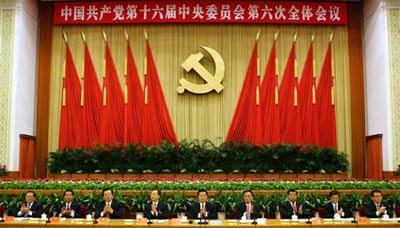
China's top leaders sitting on the stage at the plenum


The annual plenum of the China Communist Party central committee closed on Wednesday and issued the most important result of the meeting, a resolution on “several major issues about building a harmonious society.”

An editorial on People’s Daily, the major party mouthpiece, called the resolution a “guiding document” for the harmonious-society endeavor. The party initiated the drive as the core maneuver to tackle the widely spreading economic inequality among people from different classes and regions in China, as the country has been labeled by some as one of the most unequal economies and societies in the world.

The resolution portrayed the harmonious society as being “built and enjoyed by all Chinese people under the leadership of the CCP.” The concept was also labeled as the essence for the party’s course of building a China-style socialism society.

Through the declaration of the meeting, the party admitted that there were many conflicts and problems within today’s Chinese society, and urged party members to try their best to “increase harmonious elements as much as possible, and decrease the un-harmonious elements as much as possible.”

Specific goals of establishing such a society were articulated by the meeting, including a sounder judicial systems, reining the trend of the widening gap between rural and urban area, boosting technology innovations and "obvious improvements" of environment.

Bold economic developments and emphasis on social fairness and justice were cited as the basis for achieving a harmonious society. The meeting pledged to establish systems that will guarantee social fairness and justice, help the development of rural villages, make education development the priority, and improve public health care and environment protection. The party also mentioned establishing better anti-corruption mechanism and strengthening supervision of party officials.

These goals are set to be reached by the year of 2020, the declaration said.

Generally speaking, these principals and goals are old messages to Chinese people, except for a few things such as the stress on social fairness and intra-party utility, which suggests factional conflicts within the party. Some of the discourse is simply reiterating those that have been sung for many years by the party, although under different names, be it establishing China-style socialism, socialism market economy, or accomplishing the preliminary stage of socialism. Many of these goals have yet to be really achieved.

Among the initials mentioned in the plenum declaration, nothing substantial was mentioned about political reform. The focus was mostly on economy and social developments. The one-party ruling system was resolutely upheld, like always.


Elizabeth Economy, director of Asia Studies at the Council on Foreign Relations, said the question now is not the goals or the strategies, but secondary strategies used to achieve the goals.

“The issue is not what has come out of Beijing’s mouth, as much as it is what is Beijing doing to ensure that what has come out of its mouth is being implemented at the local level,” said Dr. Economy.


----by Josie Liu

Friday, October 06, 2006

CCP Central Committee to Discuss Building Harmonious Society


The annual meeting of the CCP central committee will start on Sunday. The three-day session is expected to discuss in detail maneuvers to achieve the goal of building harmony in Chinese society, with a stress on fairness.

Observers also expect to see the party discuss more efficient ways of cracking down corruption, to maintain its legitimacy and a welcoming image of itself among the public.

Personnel change is also closely watched. There are a lot of speculations that a younger generation of officials, who are viewed as more pragmatic and open- minded, are going to be positioned in some key posts, getting ready for in-side party elections next year on the 17th party congress. Also, these promotion-hopefuls will mostly share the vision with the current leadership.

However, most observers agreed that this is not the time for any major shift in China’s current system and political-economic policies. The long-existing lag between political and economic reform will continue to persist, and serious or institutional political reforms will have to wait till a new generation of leadership, who is expected to take over power in early next decade.

----by Josie Liu