Showing posts with label civic rights. Show all posts

Wednesday, April 11, 2007

Public Outraged over Security Guard Killing Bank Customer


The bank in Shenyang where a customer was shot by security guard


Thousands of people have posted comments on online forums in China, expressing their shock and rage over the killing of a customer by a finance guard in a bank in Shenyang, Liaoning.

Ji Cheng, a 33-year-old man of Shenyang, was shot dead on Saturday after failing to stop upon the request of a bank security guard.

He went to the bank that afternoon to withdraw some money and then walked his way to the door, when a security guard asked him to stop, because the bank was in the process of transferring cash onto a vehicle to be escorted to where the money will be stored. On duty were officers from the Finance Guard Center of Shenyang, a unit run by Shenyang Police Department and providing services like money escorting and guarding banks.

Mr. Ji told the security guard that he was in a rush to do something and had to leave, and the guard said to him, “Are you pretending to be an a…hole? I will shot you if you walk one more step.”

“I am going to walk one more step. I will see what he can do,” Mr. Ji told his friend who was with him in the bank, and kept walking, according to Southern Metropolis Daily.

The security guard then called outside for help, and Zhu Honglin, an armed guard, rushed in and shot Mr. Ji in the face. Mr. Ji died instantly.

“The sky is about to fall!” One person wrote on a forum upon reading the news, which was first broken out on an online forum. “Upon reading [the story], I feel chill all over. Life is treated like a grass. Where can you and I find a safe place?”

The poster is not alone in being stunned and appalled by the incident and concerned for personal safety even at a public place like a bank. Hundreds of others posted similar comments.

But people are not just terrified. Rather, they are infuriated. The reactions demonstrate Chinese people's increasing sensitiveness to citizen rights as well as possible violation of such rights by authorities.

Many online comments condemned the guard for abusing his power as a member of a police-associated entity and his privilege of caring a gun, and called for justice and respect for citizens’ rights.

Calling the killing a “murder,” people asked over and over again: “Who gave the security guard the right to kill innocent people?” “Is it necessary to open fire to an unarmed man?” Even if a shot is inevitable, “is it necessary to shot the head?”

They also questioned the legitimacy of the shot because Mr. Ji apparently was not posing any threat and did not use any violence. The guard should have at least fired an empty shot to warn him first, instead of killing him right away, people say.

Only a handful of posts argued that the guard was just doing his job. One officer of the Finance Guard Center was killed during a bank robbery in 2003, and some people argued that officers were operating under tight nerves.

Mr. Zhu Honglin, the 25-year-old officer who fired the lethal shot, has been in police custody “under criminal charges,” and investigation is underway, local media reported.

Online comments
http://www.tianya.cn/publicforum/Content/free/1/888999.shtml
http://www.tianya.cn/publicforum/Content/free/1/888889.shtml
http://www8.tianya.cn/new/publicforum/Content.asp?idWriter=3857561&Key=64684859&strItem=free&idArticle=888661&flag=1
http://bddsb.dzwww.com/bdxw/200704/t20070411_2102347.htm
http://club.cat898.com/newbbs/dispbbs.asp?boardID=1&ID=1593033&page=1

Tuesday, April 03, 2007

House Owners “Disappeared” after Nail House Demolished

The "most incredible nail house in history" being struck down

Wu Ping and Yang Wu seem to have disappeared along with their nail house, which was finally struck down on Monday night after the couple reached an agreement with real estate developers.

They accepted an offer of a same-size property at a different location as the exchange for the nail house, plus 900,000 yuan ($112,500) of compensation for their business loss due to the redevelopment construction.

Journalists, however, were not able to reach the couple for comments on the finale of their long and widely publicized fight for their property. Ms. Wu Ping, who was eager to talk to journalists in the past couple of weeks, turned off her cellphone, an action so unusual for the media-appealing lady that some journalists were concerned about her personal freedom. An official from Jiulongpo District Court, which facilitated the final agreement, assured the press that the couple “is absolutely free,” but simply too tired to talk to journalists.

Ms. Wu Ping and the developers resumed negotiation on March 25, but again refused to see each after failing to reach any agreement on the compensation plan. The breakthrough came along after Wu Ping met with the Party Secretary, the top leader, of Jiulongpo District on March 28. The two had a three-hour talk and after that, “Wu Ping’s attitude changed significantly,” officials briefed the press on Tuesday.

Right after an agreement was signed on Monday, Yang Wu left the nail house by himself, along with the national flag and the banner showing right-defending slogans.

In just a few hours, the famous nail house, which has been watched by the entire world and seen by many as the symbol of Chinese citizens’ resolution to fight for their property right, collapsed to the ground. The time was 10:36 pm.


Video of the demolishing
http://bbs.cqnews.net/dispbbs.asp?boardID=72&ID=53992&page=1

Video of the court’s press conference on Tuesday
http://cqtoday.cqnews.net/system/2007/04/03/000778057.shtml
http://cqtoday.cqnews.net/system/2007/04/03/000778236.shtml

News stories about the press conference
http://cqtoday.cqnews.net/system/2007/04/03/000777941.shtml
http://cqtoday.cqnews.net/system/2007/04/03/000777943.shtml

Sunday, April 01, 2007

Nail House Demolishing Deadline Set, Yet Again

Huang Yun, chief of Jiulongpo District, showing a image of the redeveloped area at a press conference


The newest deadline for Yang Wu to leave and have his house removed is April 10.

This is the third time the local court issued such an order to Mr. Yang, and the two-story house is still standing while Mr. Yang is still staying in the building that has been vacant for more than two years, without running water and electricity.

The court ruled on March 19 that Mr. Yang should allow demolishing of his house by March 22. He did not. The case was then transferred to the court’s execution bureau, which ordered the house be removed by March 29. Yang again ignored the order. On March 30, the court sent him yet another notice, which was supposed to be the ultimatum for him to obey the court’s order. If he failed to do that again, the court will “carry out the demolishing forcibly at an appropriate time,” local officials told the media.

Negotiation is still under way. The crux of the conflict between Yang Wu and the real estate developer is how he should be compensated for his property.

Mr. Yang and his wife Wu Ping have refused to accept more than 2.4 million yuan ($300,000) of cash the developer would pay to them, but asked for an unit of the same position and area as their current property in the new business compound to be built on the same location, which happened to be a major commercial area in the city.

Local officials also said the couple asked for another 5 million yuan for the economic loss they suffered due to the redevelopment, since their house was used as a restaurant before the ground was broken, a condition the developer did not consent.

In recent conversations with journalists, Wu Ping has not insisted on the 5 million money request, only claiming that all she is asking is property on the same spot.

Chongqing officials brief the press
http://cqtoday.cqnews.net/system/2007/03/31/000776469.shtml

Investigative report by Southern Weekend
http://news.163.com/07/0329/11/3AOEIUAL00011SM9.html

Thursday, March 29, 2007

Young Blogger Took on the Coverage of Chongqing Nail House


Other homeowners protesting on the site of the Chongqing nail house (left)
Looking at the construction site from a nearby light rail station (right)

While the Chinese public is hungry for the latest update about the Chongqing nail house after the mainland media were largely squelched in their coverage, thanks to a young and restless blogger, people are now satisfied with on-site reporting published online.

Being perhaps the first non-journalist blogger in China to do original field reporting, Zola Zhou, a 26-year-old Hunan native, boarded a train on Monday and arrived in Chongqing early Wednesday “like a crazy rock,” on his own expense.

“News sensitivity and the desire to become famous overnight” brought him to Chongqing, he writes in his blog entry. By asking around, he found his way to the construction site where the nail house was still standing.

On Wednesday afternoon, he met Wu Ping. “Seeing her with my own eyes, [I] do not think she looks like a tough spicy girl [Chongqing women are nick-named “spicy girl” for their well-known pungent style], but an intelligent and well-mannered intellectual,” Mr. Zhou wrote. “[She] talked appropriately, like an experienced spokeswoman.”

He only had a two-minute conversation with Ms. Wu, who told him that despite the widespread rumor about her special background, the only background she had was “the law.” She also told Zhou to “be careful of health and safety.”

“Her heart is calm and strong, and deserves my trust and support,” Mr. Zhou wrote in his blog, published sometimes via his cellphone right on the scene.

Interestingly enough, Mr. Zhou met other home owners from Shanghai, Guangzhong, Zhuhai, Chengdu and Xi’an, who gathered at Wu Ping’s property site to propagate their own story of losing homes to redevelopment projects, since this place has attracted many journalists, domestic and foreign.

These people brought over pictures of their demolished houses, documents proving their legitimate rights to the properties and signs denouncing the government or claiming their own rights. A man from Xi’an even gave a public speech at the construction site, opposing the use of “nail house” on those who defend their properties, Mr. Zhou reported. Local people also told him that several cameras were installed in the trees and on the walls surrounding the site.

But what he reported is not as extraordinary as the reporting journey itself.

His action has won almost universal support in China’s cyberspace. Hundreds of people left comments on his blog and other sites that republished his posts, among which the words “support,” “be safe” and “be careful” appear most frequently. His readers apparently are concerned that he may get into trouble with the authorities.

Mr. Zhou is hailed by many as a grassroot hero as well as a “citizen journalist,” or “independent journalist.” Some praised Zhou as making history among Chinese bloggers by doing such original reporting, and called his endeavor revolutionary.

People expressed their disappointment and distrust of official media, while placing on Mr. Zhou their hope of getting the true story of the incident. “Now only such an individual media like you is trust worthy,” a web user named Jorin writes.

Another poster says he heard rumors that the house has been demolished, only to find the information untrue after reading Zhou’s report.

“Keep digging deep, looks like [I] can only know the truth from you,” a poster named HP writes.

People not only give him emotional support, but material one, too. By Thursday, supporters have wired about 1700 yuan (more than $200) to Zhou's bank card and telephone card. “I am not alone,” Zhou writes.

Currently not employed, Mr. Zhou has been spending a lot of time maintaining several websites of his own. He had received some computer skill training but never went to college. He described himself as an optimistic guy, “willing to help those who are really in need,” and aiming at becoming a “righteous, strong and dare-to-dream man with money.”

This young man has also been influenced by the entertaining spirit of the media culture in Hunnan, and claims his website to “entertain the mass,” a task he has well fulfilled with the field reporting from Chongqing.
(photos courtesy to Zola Zhou)

Saturday, March 24, 2007

Some Online Coverage of the Nailhouse still Alive

After the official ban on news coverage of the holdout in Chongqing was issued on Saturday, news broken by a Chinese blog, the special section about the incident on sina.com.cn is no longer there.

However, a couple of websites covering the holdout is still accessible on people.com.cn, one of the major state-run gateway websites, which is supposed to follow official publicity guidelines.

Similar coverage is also available on some commercial websites like NetEasy and sohu.com, by the time this post is published.

Here are the links:

people.com.cn
http://finance.people.com.cn/GB/1045/5510689.html
http://unn.people.com.cn/GB/14748/5513146.html

other sites:
http://news.163.com/07/0324/14/3ABVC5LQ0001124J.html
http://news.sohu.com/20070324/n248944151.shtml

the ban on press coverage
http://chinadigitaltimes.net/2007/03/chinese_government_forbidden_media_reports_about_the_na.php

Friday, March 23, 2007

Family Killed Officials and Refused to be Relocated

Ms. Wu Ping held an impromptu press conference next to her disputed property (left)

The house in question: the only one left on the construction site (right)


The episode of a Chongqing couple’s prolonged struggle of refusing to have their house demolished is not over yet, while a family in Jiangsu allegedly killed two people for the same kind of dispute: home demolishing and relocation.

On Thursday, Ma Xueming, a Suzhou resident, allegedly attacked and killed Zhang Jinlong, a manager of a relocation company, along with a female local community administrator, and injured another man from the company. The three people came to Ma's home to talk about compensation plan for demolishing his property and relocating his family due to a development project.

Mr. Ma were said to threw lime powder at the visitors and then stabbed them, witnesses told a local newspaper.

Police took away Mr. Ma, his wife and a teenager son right after the incident. The family was the only one yet to be relocated in the village, because they had not reached a compensation agreement with the real estate developer.

People who knew the family said they were quiet and honest people, and that it was “inconceivable” that they would take such “extreme actions,” local newspaper reported.

Upon reading the story, many web users point out that people in Suzhou are usually good-tempered. Now that even such nice people also start to violently resist relocation for real estate development is a signal that such practice has aroused huge public resent.

Most people don’t agree with the killing, but many express sympathy for the Ma family as well as their own hatred of government officials and relocation company personnel who often force people to move.

Many call the incident a tragedy, some compare Ma’s action with communist revolutionaries’ rebellion over half a century ago, and still some see the incident as yet another indicator of people’s fury against the government, who, as put in one comment, “has become the accomplice of real estate developers for the red and green paper [money bills].”

“The volcano is about to explode,” one posted a comment as saying.

“If real estate developers and local governments still don’t rein in on the brink of the precipice, more similar incidents will continue to occur around the country…and constantly undermine harmonious society,” another one writes.

“This is a typical case of [the result] of power overshadowing law. Grass-root people have no power and can only fight with death,” still another says.

The Suzhou incident was by no means the first time people died in conflicts regarding relocation. Two years ago, for example, an old couple in Shanghai was burnt to death in the house they refused to move out to make way for a development project. Shanghai government later announced that the arsonists were people from a local relocation company.

Meanwhile, a lot of public attention is still on the story in Chongqing.

The deadline of Thursday, which was set by a local court for Yang Wu and his wife Wu Ping to allow demolishing their house, passed without much happening. Construction workers have set up fences around Yang’s standing-alone property to stop people other than him, his wife and journalists from coming close. The couple tried to move back to live in the house a few days ago. They haven't lived there for about two years.

According to Chinese law, the court will enforce its ruling under coercion if Mr. Yang failed to obey it, but the court has yet taken any action. Court officials told state media that the court needed some time to carry out the enforcement. Wu Ping also told a dozen of journalists from around China that she was willing to give up her house if an agreement could be reached.

Suzhou killing
http://paper.people.com.cn/jnsb/html/2007-03/23/content_12642385.htm

Online comments
http://www.tianya.cn/publicforum/Content/free/1/879734.shtml
http://comment4.news.sina.com.cn/comment/skin/default.html?channel=gn&newsid=1-1-12589815&style=0

Chongqing conflict
http://finance.people.com.cn/GB/1045/5510689.html
http://news.sina.com.cn/z/cqzndzh/index.shtml

Wednesday, January 17, 2007

Village Women Fight for Rights

Discriminated village women try to sue their village


When her village sold a piece of land for real estate development in 2004, Li Chengying was told that she would receive nothing from this sale. The land belonged to all residents in the village on the outskirt of Yanan city in Shaanxi province, and the earning, about 22 million yuan (less than $3 million) in cash, was supposed to be distributed among all villagers. But Ms. Li and more than 30 other women were excluded, simply because they married to men from out side of the village.

Normally, if married to outsiders, women in rural China would move to their husbands’ town. But for some reason, Ms. Li and those other ladies stayed in the village where they were born and raised. Yet for a long time, they felt being discriminated.

“When it comes to fulfill obligations, there is no difference [between us] with [native] male residents. But why are we treated as unqualified villagers once it comes to distribute income?” The ladies complained when being interviewed by the China Youth Daily.

They argued with the village administration in 2004, and were allowed to collect signatures from fellow villagers. If over half of the villagers signed an agreement consenting to share the land sale earning with the ladies, they would get their cut. The ladies collected 72 signatures out of 113 residents and received a copy of the agreement, with a seal of the village administration on it.

Before they ever received the payment, however, the administration changed and the new leaders denied the agreement. Many villagers also changed their mind and did not want more people to participate in the distribution.

Ms. Li and her female fellows appealed their case to upper level governments all the way up to the provincial government, only to see the case be returned to the village at the end of the day. The higher offices refused to interfere directly because there is a “Villager Autonomy Law,” according to which village affairs are supposed to be decided by villagers themselves.

“Is the villager autonomy law bigger than the constitution?” Ms. Li questioned. The lady, whose highest level of education is the first grade, said she studied China’s constitution, which claims equal rights for all citizens, and that village policies should be in accordance with the constitution.

Her argument, so far, is just an argument. When the ladies went to a local court to sue the village, the court did not even accept the case, citing “requests from leaders” that the court should not accept law suits concerning distribution of village’s collective income, like that from the land sale.

Ms. Li and the other ladies have hired a lawyer and continue their legal pursuit.

As a matter of fact, they are not alone in such village discriminations. Women married to men from other places but remain living in their home villages suffer unfair treatments in many rural areas across China. Traditionally, and still the case in China’s millions of villages, married women are no longer considered a member of the family they were born into, but a member of the family they married into. For women who are not able to move to their husbands’ origin places, they can not enjoy the men’s native rights, while their own are denied.

Some of them have started to fight back. A few women sued their villages for denying their rights, including dividend from land sales, and won. There are of course unsuccessful battles, and perhaps even more village women in such situation simply endure the unfairness silently.


----by Josie Liu

Wednesday, January 03, 2007

City Residents Raising Money on Their Own to Build a Park

Residents in a meeting discussing their bid


The planned park


Concerned that an open space in their residential area in Guangzhou City will turn into more skyscrapers, some residents decided to build a public park on the spot by raising money on their own, an initiative pretty innovative for China's urban residents.

The park, in fact, was not a new idea. Six years ago, a planned park was included in the advertisement for the property and played as a major attraction to many home buyers. But the park never really came into being. For the past years, residents occasionally played soccer or flied kites on a piece of bare land, on which the park was said to be built, Guangzhou-based Information Times reported.

While looking forward to a nice park in an area surrounded by more and more new buildings, residents heard in 2002 that the government planned to use the vacant spot for commercial purposes. Residents were worried. “We are seeing closer and closer distance between buildings, and more and more traffic signals, but the government still wanted to change the planned park into more residences,” one of them said. Loathing the idea of living in another concrete forest, home owners decided to do something.

Learning from some government officials that the government had difficulty to fund the park, the residents volunteered to raise money by themselves. They are drafting a report to submit to Guangzhou municipal government, asking for permission to build a big city park, with fountains and recreational facilities, on the open space and they will pay for the construction expenses of about 30 million yuan (about $4 million).

Meetings have been held among interested home owners and the fund raising efforts so far have been promising. However, after all, these people do not own the land. The government does, instead, and it has the right to develop the land into whatever it likes.

Obviously, building hotels and business towers could bring much more income to the government than creating a park. To make things more difficult, the residents are trying to negotiate with the government to let them build the park at zero land cost. Unfortunately, a city government is not a charity, let alone the fact that the government could charge up to 250 million yuan for using the land. In addition, a real estate company is also eyeing on the piece of land, and it is willing to pay for the price of using it. Taking such big interests into account, an expert predicted little luck for the residents’ bid.

If the residents succeeded in the pursuit, they will set a glory example of urban Chinese residents’ grass-root fight for a better living environment. If they failed, well, it will just be another real estate project in an already over crowded metropolis, like what is happening almost everyday in China.


----by Josie Liu

Tuesday, December 19, 2006

Retired Provincial Leader Targeted for Pleads

Mao Zhiyong, former party secretary of Hunan province, has not enjoyed much peace as he hoped since he chose to retreat to his rural home village and live a farmer’s life three years ago, after stepping down from office.

His after-retirement life was recently featured in The Beijing News, which apparently has been very busy.

The 77-year-old man has an impressive political resume, including 16 years as the party secretary, the top official of Chinese province, of his native Hunan province, another three years in Jiangxi province in the same post, and several years as the vice chairman of Chinese People's Political Consultative Conference. Such a strong background makes people in the village and nearby believe that Mr. Mao is a powerful figure.

Local officials come to his home regularly, seeking advices on local issues. Using his resources and connections, he managed to have a Hong Kong businessman to take over a pig farm in the village, which created new jobs and businesses, and helped villagers to make more money.   

Not only better economy, he also attracted appealers from local and outside towns, who hoped Mr. Mao could help to claim their rights or seek justice. But the best Mr. Mao could do is no more than writing a letter to responsible officials, asking “please deal with [the case] in accordance with due policies.” On lucky days, the note could generate some feedbacks from Hunan and Jiangxi governments, where Mr. Mao once served as the chief.

To make sure that his life would not be disturbed too much, local police set up a guard booth near his home to provide 24-hour protection.


Mr. Mao’s return to rural village made big news three years ago, since it is not usual for such a high-ranking official to leave prosperous city and settle down in relatively backward country side. He wanted to go home, farming and raising chicken, because in the village, “the water is good, air is good and vegetable is good,” he said.

The attention he received in his home town, however, is predictable. High-ranking officials always trigger big excitement among lower officials as well as common folks in China, as in many other places around the world. Besides, they often possess substantial political influence even after they retire.

It’s also no wonder that appealers with all kinds of sad stories and broken rights would try to seek help from this retired former powerful, since they often fail to get much response from sitting officials.


----by Josie Liu
http://news.sina.com.cn/c/2006-12-20/023611835695.shtml
http://news.sina.com.cn/c/2006-11-28/170211644858.shtml

Wednesday, December 13, 2006

Warning: Non-direct-interest Conflict Growing in China

The number of social riots in China has been increasing in recent years


China is seeing a dangerous trend, the increase of non-direct-interest conflict, where many participants of protests or clashes with the police actually have nothing to do with the issue at question itself, but only use the participation as a way to let go their anger or doubts toward the government.

The problem is discussed in an article published in the December issue of Baixing magazine, an out-spoken media outlet based in the mainland.

In recent years, it is not rarely seen that some small quarrels in the streets evolved into large-scale riots involving tens of thousands of people, many of whom had no specific interest pursuits in the protest.

The trend is manifest among migrant workers in Guangdong, for example. Those who had specific interests at stake and those who did not often mixed together in protests. Often times, it was spectators, not the protestors, who threw stones at the police, the article says.


However, the phenomenon is far from simply people’s meddling, but rather demonstrates the conflict of interests between different groups, if not necessarily individuals, the article goes on to point out.

For instance, a farmer selling vegetables on the road side without authority permission was asked to leave by some city inspectors but refused to do so, and a fight broke out between the two sides. Hundreds of people walking by started to join the fight, mostly sympathetic with the farmer and criticizing the inspectors for not allowing the farmer to sell his products and to make a living. Among the crowds might be people who had similar experience of being pushed around by authorities and held the feeling of being oppressed. Therefore, non-direct-interest conflict is “group-to-group conflict; is the formation and division of social stratus,” the magazine article says.

“Due to past unfair treatment [from the authorities], [people] accumulate antipathy over time and feel themselves being the obvious or potential subject of persecution, and therefore try to let the feeling off their chests when there is a chance,” especially when they do not have sufficient channels to complain or defend their interests, says the article.

The peculiar conflict is characterized by an attitude that “nothing [done or said by the government] is trustworthy,” the magazine says. It warns that the problem, if not dealt with properly, could eventually harm the foundation of government ruling, because it sends a dangerous signal showing antagonism between government officials and the public.

The article attracted many discussions after it was posted on the Internet last week. Most of the commentators expressed their sympathy toward such non-direct-interest conflict.


Some say it is the result of non-electoral designation of government officials, and a way for the public to express their opinions. Some interpret it as the manifestation of the increasing class conflict in today’s Chinese society, the conflict between those who have privileges and the mast majority of plain citizens, or lao bai xing. There are also voices haling such public involvement in conflicts, calling it people’s awakening and social conscience.


----by Josie Liu

Thursday, November 30, 2006

Survey: Chinese People’s Attitudes toward AIDS Mixed


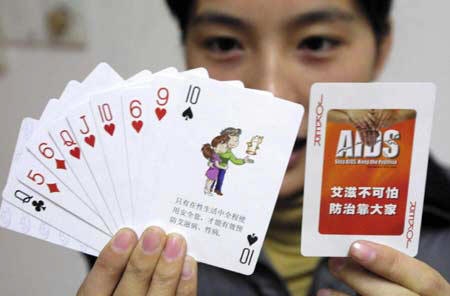
In some places, knowledge about preventing HIV is printed on poker cards for public education


Most Chinese people in a survey showed tendency to avoid contact with HIV affected people, although they supported equal rights for this group.

Over sixty percent respondents agreed that HIV affected people should have the same rights as other people to work and receive education. About sixty percent, however, responded that they would not be willing to continue to work with people tested HIV positive, according to the survey, conducted by sina.com before the Dec. 1 World AIDS Day.

For a multi-choice question about whether people would tell others if they themselves were found to have AIDS, more than 80 percent responses went to informing parents, lovers, good friends and people they had “intimate contact” with. There are also 40 percent responses going with not telling anybody.

What would people do if they knew their neighbors were affected? Forty-seven percent of the respondents said they would try to avoid contact with the affected person, 10 percent said they would move, and three percent would visit the affected person at home. There are also 41 percent choosing to continue to live like usual.

By October, there have been more than 180,000 AIDS cases reported to Chinese authorities over the years. Among the cases reported during the first 10 months of this year, 37 and 28 percent were affected through drug and sexual activities, respectively, Xinhua reported. Chinese officials say there are still dangerous factors to cause further spread of AIDS in the country.


----by Josie Liu

http://news.sina.com.cn/z/aids2006/index.shtml
http://news.sina.com.cn/c/2006-11-30/204211665848.shtml

Friday, November 10, 2006

Protesters Clash with Police over Land Disputes


Villagers in Sanzhou, Guangdong, confronted police


More than 10,000 people clashed with riot police in the village of Sanzhou, Guangdong, on Friday, during a protest over land dispute. NBC news aired footage of the clash on Friday morning, showing police using tear gas to disperse the crowds in a chaotic scene. This was one of the biggest clashes between protesters and the police since the 1989 Tiananmen Square incident, NBC said.

Villagers in Sanzhou have been protesting against illegal seizure of their land by local officials and corruption for months and on Wednesday, they detained a few foreigners and government officials in a warehouse which they said was built upon such disputable land. The officials and guests from Hong Kong, Germany, Thailand and Britain were in there for the facility’s inauguration ceremony. The officials and guests have been let out by Friday, the South China Morning Post reported.

Land disputes have been one of the major causes for uprisings in China, especially in rural area, in recent years. In most of the cases, villagers protested local officials' grab of farmland and selling it to real estate developers. Local governments could gain tremendous profits by selling the land while villagers sometimes receiving little compensation or nothing at all. Such land deals are also plagued with alleged corruptions and foul plays, such as bribery between real estate developers and government officials and selling farmland that are supposed to be preserved as farmland.

The central government has warned local officials against illegal land seizure, but the rapacious land demand for real estate developments and limited supply, in addition to huge profits, could almost annul the warnings.


----by Josie Liu
http://www.msnbc.msn.com/id/15653408/
http://china.scmp.com/chitoday/ZZZ86XL47UE.html