Tuesday, September 26, 2006

Public Stunned, yet Pleased by the Removal of Shanghai Top Official


City view of Shanghai


Millions of people commented on the Internet in the last couple of days, hailing the sacking of Chen Liangyu, former party chief of Shanghai, who allegedly involved in the city’s recent social security fund embezzlement scandal.

The Political Bureau of the Central Committee of the Chinese Communist Party made the decision on Sunday to remove Chen Liangyu from office, including his post in the Politburo, and start an investigation on his role in the pension fund scandal. Preliminary investigation showed that Mr. Chen was involved in the embezzlement. He was also found seeking interests for illegal entrepreneurs, providing illegitimate benefits for his relatives, and shielding his staff’s misconducts, Xinhua reported.

The move was to the surprise of the majority of the public. “It’s sudden, but reasonable,” one wrote on the Internet. Most people did not expect such severe punishments for Mr. Chen, who not only had a position in the politburo, but also headed the largest and most prosperous city in China. He was also seen as a member of former Chinese president Jiang Zemin’s clique.

Many observers said Mr. Chen’s fall indicated President Hu Jintao’s final take-over of the full power, and the ending of Mr. Jiang's influence on national politics. Others said the move was more than power struggle, but was part of Mr.Hu’s plan to crack down on party and government officials’ corruption, which has been prevalent in almost every government and party branch across China, and deeply rooted in the political system. They saw this move as a hope for restoring a clean, integral political arena.

One observer wrote that Chen Liangyu provided a good opportunity for President Hu to demonstrate that he was willing to remove anyone who committed corruption, so as to admonish other officials. And the timing was good, too. The communist party is expected to go through major personnel changes when the party’s 17th national assembly opens next year. There are speculations that half of the members of the politburo standing committee will retire after the assembly. With a largely new politburo standing committee, which sits at the top of CCP hierocracy, it is easier for Mr. Hu to implement new policies, including a tougher surveillance system to tackle corruptions.

On Tuesday, an official from CCP’s central disciplinary committee said that last year, more than 11,000 party members were dispelled from the party due to corruptions, Xinhua reported.
http://news.xinhuanet.com/politics/2006-09/26/content_5140344.htm
http://washeng.net/HuaShan/BBS/shishi/gbcurrent/151045.shtml
http://news.xinhuanet.com/politics/2006-09/26/content_5139867.htm

----by Josie Liu

Friday, September 22, 2006


Vehicles and bicycles competing for roads in Beijing


Calling Back Bicycles

Environmental protection organizations in China issued a letter on Friday, calling on the public to ride bicycles, instead of driving cars, to get around, like they used to, because bicycle riding is “more fun, healthier, faster and more environmental friendly.”

For decades, riding bicycle used to be the main transportation for people across China. But as more and more people start to drive their own cars, not as many people ride bicycles any more. Meanwhile, fast growing vehicles are deteriorating urban transportation in almost all major Chinese cities, and conflicts between vehicles and bicycles on the road are escalating as vehicles start to run on bicycles lanes when their own are overcrowded.


Liang Congjie, delegate of the Chinese People’s Political Consultative Conference, China’s top policy consultative body, told the Beijing News that it no longer feels safe to ride bicycle on Beijing’s roads. Liang, 74, who is also a famous architect and environmentalist, stopped riding bicycle in Beijing only recently, after falling from his bicycle when attempting to avoid a suddenly-coming vehicle. “If vehicles in Beijing don’t yield to bicycles, it will be very dangerous to ride bicycles in Beijing.”


Why? Mr. Liang cited several problems, including: some newly built roads do not have bicycles lanes; existing bicycle lanes are occupied by fast growing vehicles or taken as parking spaces. “These circumstances undermined bicyclists’ right of the road, and damaged the transportation resources of bicycles,” said Mr. Liang.

On Thursday, Qiu Baoxing, deputy chief of China’s state administration of construction, told a city planning forum in Guangzhou that China should adopt a compact model for city development, not the wide-spread model of the United States, Southern Metropolis Daily reported.


According to state planning, total highway miles in China will exceed that of the US by 2035, making China the No.1 country in the world in terms of highway area and energy consumption for transportation. “This is something very formidable, ” Mr. Qiu said.
http://news.sina.com.cn/c/2006-09-22/232810086001s.shtml
http://news.sina.com.cn/c/2006-09-23/000810086690s.shtml
http://news.sina.com.cn/c/2006-09-22/093411076657.shtml


Bad Behavior of Chinese Tourists Censured

A list of bad behaviors of Chinese tourists in overseas sites was published Friday on the website of China National Tourism Administration. The denounced behaviors include littering, spitting, not flushing after using toilet, ignoring No Smoking signs, cutting in front of others while waiting in line, talking loudly in restaurants, hotels or on plane, sporting and joking at religious sites, speaking bad words freely, behaving rude, bargaining at stores that don’t bargain, and taking things not for guests to keep from hotels and restaurants.

Along with the increase in Chinese people’s income are the number of Chinese tourists traveling overseas in Japan, Korea, Europe and other countries. While demonstrating their ability to purchase merchandises, Chinese tourists also show their bad manners in many ways. The tourism administration asked the public to submit what they think as bad behaviors of Chinese tourists and published the list as a way of education. The administration also issued suggestions for improvements.
http://www.cnta.com/news_detail/newsshow.asp?id=A2006922831563071664

----by Josie Liu

Thursday, September 21, 2006

Confucius Birthday Ritual Supported by Chinese Public: Survey


People dressed in ancient costumes and following traditional procedures on a Confucius birthday ritual


More than 46 percent of those surveyed by sina.com.cn said it is “very meaningful” to hold the birthday ritual to memorize Confucius, and another nearly 28 percent said the ceremonies “have some meaning.” About 26 percent said such ritual is totally meaningless. Meanwhile, 61 percent of the surveyed support the view that the sustain and protection of Confucius’ teaching is inadequate and that traditional Chinese culture is waning.

September 28 is seen as the birth day of Confucius, who was born in 551 BC. More and more places in China start to hold big ceremonies on this day in recent years to celebrate Confucius’ achievements in education, ethics, philosophy and other areas, as one way to celebrate traditional Chinese culture. Grand ceremonies again will be held this year in multiple locations in the mainland and Taiwan, and China’s state television is said to live the events.
http://news.sina.com.cn/c/2006-09-21/105311068164.shtml

China Internet Conference Kicked Off
Hundreds of big players of Chinese internet industry gathered in Beijing on Thursday for the 2006 China Internet Conference, held by China Internet Association. The meeting will focus on innovation pushed by the development of internet industry in China. Participants, including CEO of Chinese search enginee baidu.com, Li Yanhong, president of Google China Zhou Shaoning and government officials overseeing the industry, will discuss a broad range of issues including Internet safety, technology development, ethical issues and business strategies.

Internet industry has seen fast grow in China in the past decade. Last year, online shopping users reached 22 million, and online trade reached nearly $1 trillion. While millions of Chinese now surf on the Internet, about 96 percent of Chinese cities and towns have internet connections, according to China News Service.

http://tech.sina.com.cn/focus/internet_2006/index.shtml


----by Josie Liu

Wednesday, September 20, 2006


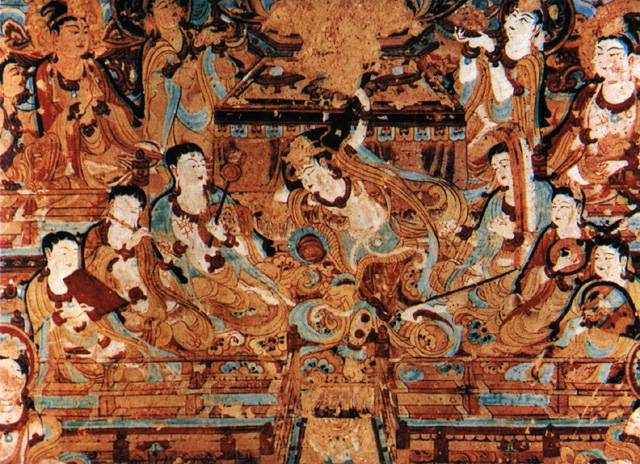
One fresco in a Mogao Grotto


Dunhuang Grotto Relics Facing Serious Damages

Experts have warned that more and more tourist visiting Mogao Grotto in Dunhuang, Gansu are bringing more harm to the precious and yet fragile fresco in the caves, Guangming Daily reported. Since 1979, more than four million visitors have been to the site, and there were over 300,000 visitors every year in the past five years and the number keeps rising. Experts say large groups of visitors cause temperature and humidity changes inside the caves, and leave a lot of vapor and carbon dioxide there, which erodes the fresco. Experts are trying to work out better approaches to protect the relics while keeping it open to tourists.

There are about one thousand grottos in Dunhuang, some made more than 1000 years ago. Most of the caves have statures featuring Buddhism figures and splendid fresco depicting images and stories based on Buddhism scriptures. The surrounding area of the grottos is mostly deserted, and the extremely dry condition has been helpful to protect the relics, which is listed as the World Cultural and Natural Heritage by UNESCO.
http://cul.sohu.com/20060920/n245438019.shtml
http://www.chinatoday.com.cn/English/chinatours/dunhuang.htm

What Chinese Cities Have the Best Life?
Shenzhen, Qingdao and Hangzhou are ranked top three cities with best living quality in China, according to a report released in Beijing on Wednesday. Shanghai is listed the fifth, and Beijing did not make top ten, China News Service reported. Other top ten cities include Yantan and Dalian. The ranking was decided by experts’ survey and evaluation, as well as public votes via the Internet.
http://www.chinanews.com/sh/news/2006/09-20/793220.shtml
http://www.shm.com.cn/newscenter/2006-09/20/content_1937666.htm

Law to be Established to Protect the Great Wall
A Great Wall Protection Regulation draft was passed on Wednesday by the State Council, China News Service reported. The new regulation will stress local governments’ responsibility in protecting the Great Wall sections within their region.

The Great Wall has been suffering damages in recent years, mostly caused by human activities, such as road construction and doodle on the bricks. There have been some local regulations dealing with protection of the legacy, but not one on the national level.
http://www.chinanews.com/other/news/2006/09-20/793334.shtml


----By Josie Liu